
Yasui Architects & Engineers, Inc.
Yasui Architects & Engineers, Inc.



A childcare facility shaping the future for children
Inuyama City Hashigo Nursery School
With the construction of its first new childcare facility in approximately 40 years, the City of Inuyama set out to create a landscape that would serve as a symbol of its commitment to childrearing.
Located about 20 kilometers from central Nagoya, Inuyama lies on the southern bank of the Kiso River at the northern edge of Aichi Prefecture. The city is known for its rich natural environment, represented by the Hida–Kiso River Quasi-National Park, as well as for its historical and cultural assets, including Inuyama Castle—a National Treasure housing Japan’s oldest surviving wooden castle keep—the historic castle town that developed below it, and Meiji Mura, an open-air museum where buildings from the Meiji era have been relocated, restored, and opened to the public.
As local governments across Japan confront population decline and a falling birthrate, Inuyama is facing the challenge of how to respond to the aging of childcare facilities built during the 1980s and 1990s. After careful consideration, the city decided to consolidate two existing facilities and construct a new one. The result is the Inuyama Municipal Hashigo Children’s Future Center (hereafter, the Center), completed in February 2025.
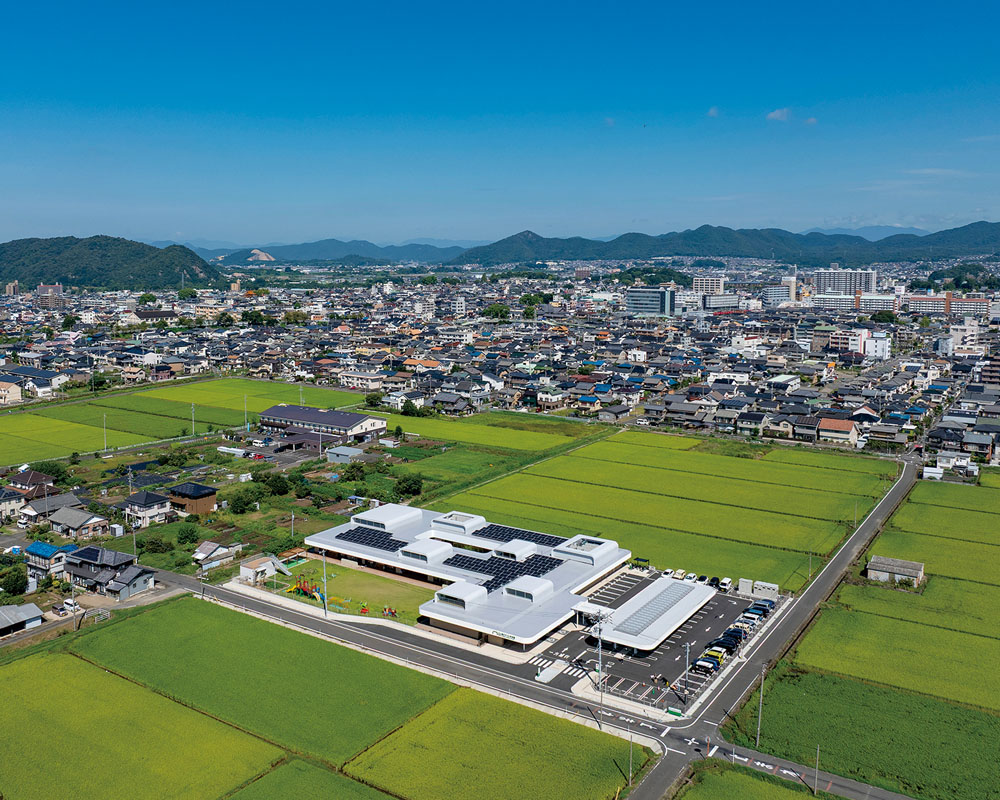
The site selected for this childcare facility—the first to be planned in Inuyama in some four decades—is located in a rural area surrounded on all sides by rice fields. Beneath a wide open sky, the single-story building stands out, with multiple gabled roofs rising from a flat roof plane, creating a striking presence even from a distance. Yukio Okumura, the design architect who led the project from the proposal stage and hails from a neighboring town, explains:
“I am very familiar with the environment of this area, so the first thing I considered was what kind of landscape we could draw in the middle of the rice fields. The site is also clearly visible from nearby arterial roads and train lines. We explored how to create a childcare facility that could serve as a symbol of childrearing within this flat landscape, working together with team members who have experience designing similar facilities.”
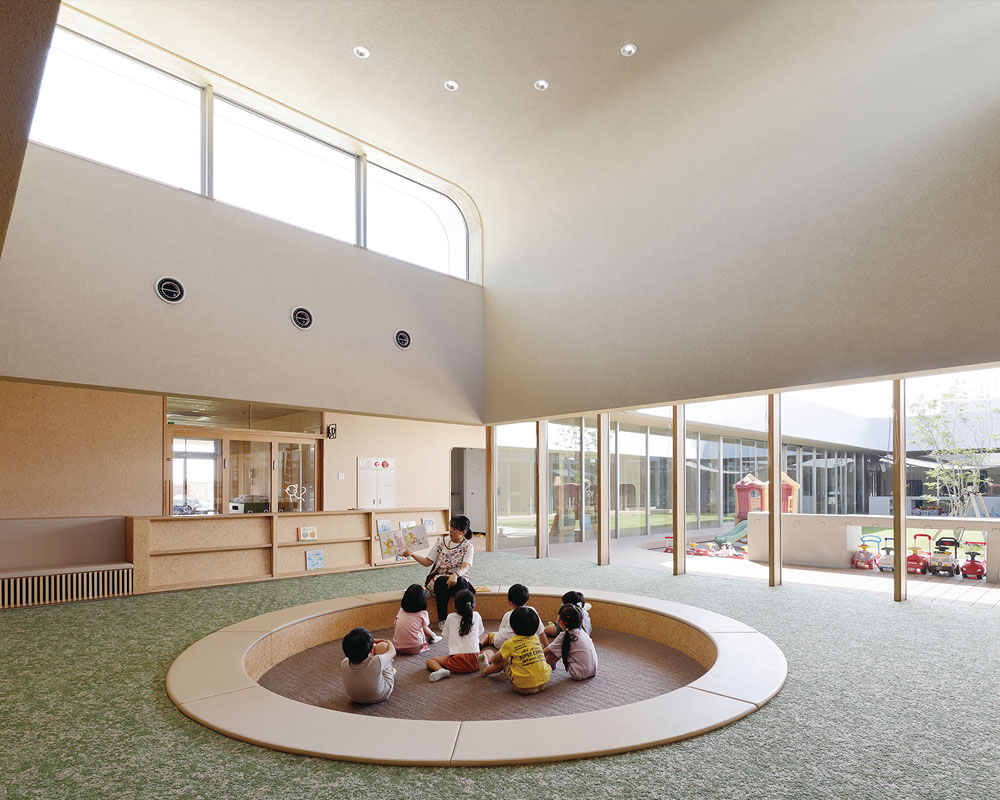
The playground and the courtyard: a semi-outdoor terrace connecting two gardens to create continuity between “inside” and “outside,” both visually and spatially
Those involved in childcare facilities likely share the same aspiration: to create a place where children can feel safe, enjoy themselves, and grow in good health wherever they are. Inside and outside the nursery building—characterized by the extensive use of gentle R-shaped curves, symbolized by the gabled roofs—wood is used throughout, from largely custom-made furniture to interior finishes. Yuji Oda, an architectural designer who, like Okumura, has worked on similar facilities in the past, explains:
“The R-shaped forms are not only for safety but also serve as design accents. Since the building is single-story, we also considered a timber structure. In the end, considering the durability required of a welfare evacuation shelter in times of disaster and the maintenance demands of a public facility, it was decided to use reinforced concrete. That decision, however, allowed us to pursue a thoroughly wood-based interior, using timber generously for furniture, walls, flooring, as well as for decks beneath the eaves and along the engawa.”
The gate roofs with their soft curves are a key feature of the building’s exterior design, and according to Okumura and Oda, they were made possible precisely because of the RC structure.
“As a symbol of a childcare facility that sparks excitement, and as an environmental device that brings light and wind into the building, the gate roofs was an idea we were keen to realize as designers. Because of past issues, the city initially had concerns about installing sky lights, but we explained that by combining deep eaves with high-side windows in the gate roofs, it would be possible to ensure natural ventilation and daylight while also making maintenance easier. This helped us gain their understanding.”
In developing the design of the gate roofs, the team examined more than twenty internal proposals, including considerations of their functions. Of the seven gate roofs installed, four form atrium spaces that provide natural ventilation and daylight, one serves as an observation terrace, and the remaining two house mechanical equipment.
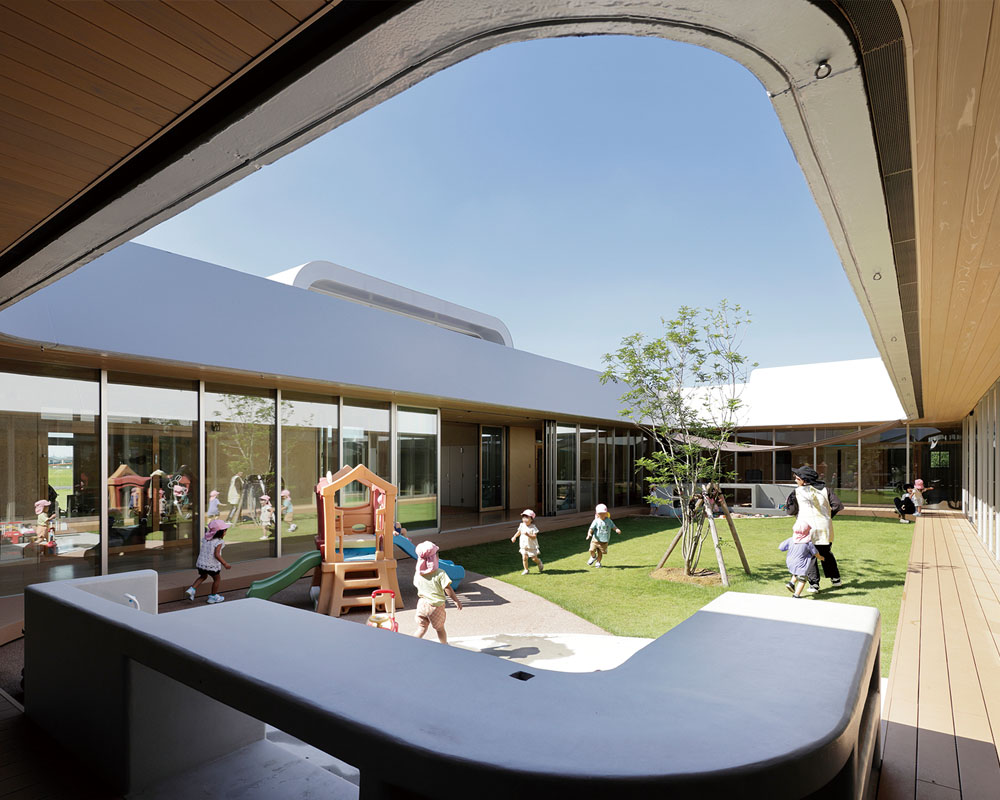
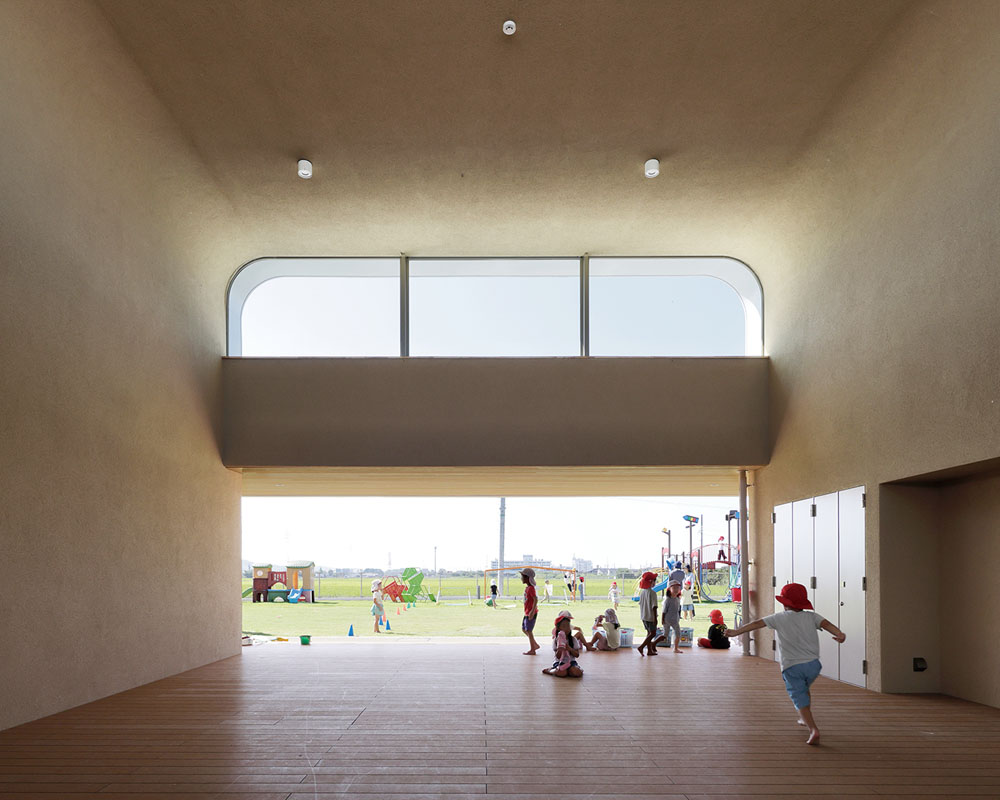
Beyond being easy to use for children, caregivers, and parents, the designers gave careful thought to the building layout in order to create a facility that lifts the spirit simply by being there. In this project, the design team planned two gardens: a playground on the south side of the building and an inner courtyard used as a play area for younger children. The courtyard is encircled by an engawa, while the two gardens are connected by a semi-outdoor terrace. The sequence of spaces—from the courtyard to the terrace, and from the terrace to the outdoor garden—created when the sashes are fully open is the nursery’s defining feature and a major source of its appeal. Regarding the square, courtyard-centered layout with an interior circulation corridor formed by the surrounding engawa, and the spatial configuration that links the two gardens through a semi-outdoor terrace, Oda comments:
“There are many advantages to having a courtyard, such as improved visibility throughout the facility, the elimination of blind spots, and shorter circulation routes for caregivers. In this project, we considered how to relate the two gardens in order to encourage interaction among children of different ages, and placed a semi-outdoor terrace between them. This allows the gardens to be connected both visually and spatially. The semi-outdoor terrace also provides a safe place for children to play even under intense sunlight or on rainy days.”
Creating a better future for children: realizing the Tokai region’s first full ZEB childcare facility through ongoing dialogue with stakeholders and the local community
Throughout this project, repeated exchanges of ideas were held with city officials, childcare professionals, local residents, and experts.
“The idea of installing a roof over the parking area emerged from a workshop. In a series of discussion sessions attended by the principals of all thirteen Children’s Future Centers in the city, we received suggestions such as installing low protective fences at classroom entrances to prevent children from running out, and providing toilet entrances at heights appropriate to each age group. All of these made perfect sense to us. By reflecting these opinions and repeatedly refining our proposals, we aimed to create a better childcare facility,” says Oda.
In addition, at the request of the City of Inuyama—which declared in 2021 its goal of achieving a zero-carbon city by 2050—the design team set out to make the building a ZEB (Net Zero Energy Building). Various measures promoting both energy conservation and on-site energy generation were introduced, resulting in the Tokai region’s first full ZEB childcare facility and the third such example nationwide among public daycare centers. Chika Terai of the Osaka office, who was involved in the project as the environmental and building services designer, explains:
“We adopted a passive design approach without relying on specialized equipment, but we were conscious of creating opportunities for people to engage with environmental issues—for example, by showing how the earth tubes reduce environmental impact through the use of geothermal heat to condition incoming air, or by making the photovoltaic panels on the roof accessible for observation.”
“As we envisioned when we first came to this site, we were able to create a building and landscape that serve as a symbol of childrearing, along with visible environmental measures,” says Okumura.
“The city officials were extremely committed, driven by a strong desire to ‘create something truly good for the future of children.’ That passion inspired us as designers as well. In design, there is never a single correct answer—the judgment ultimately lies with the client and the people who use the building. Still, hearing someone say, ‘Yasui Architects were designers who gave form to our aspirations,’ is something that has stayed with me,” adds Oda.
As the designers’ reflections suggest, this was a project advanced through a shared sense of purpose among all involved. Even before its opening in April 2025, the childcare facility attracted considerable attention. Today, many children who will shape the future attend the center, and the building—embraced by high expectations from the local community—resonates with the bright voices of children running joyfully through its spaces.