
Yasui Architects & Engineers, Inc.
Yasui Architects & Engineers, Inc.



A hotel that carries forward historical and cultural value
Hotel Indigo Nagasaki Glover Street
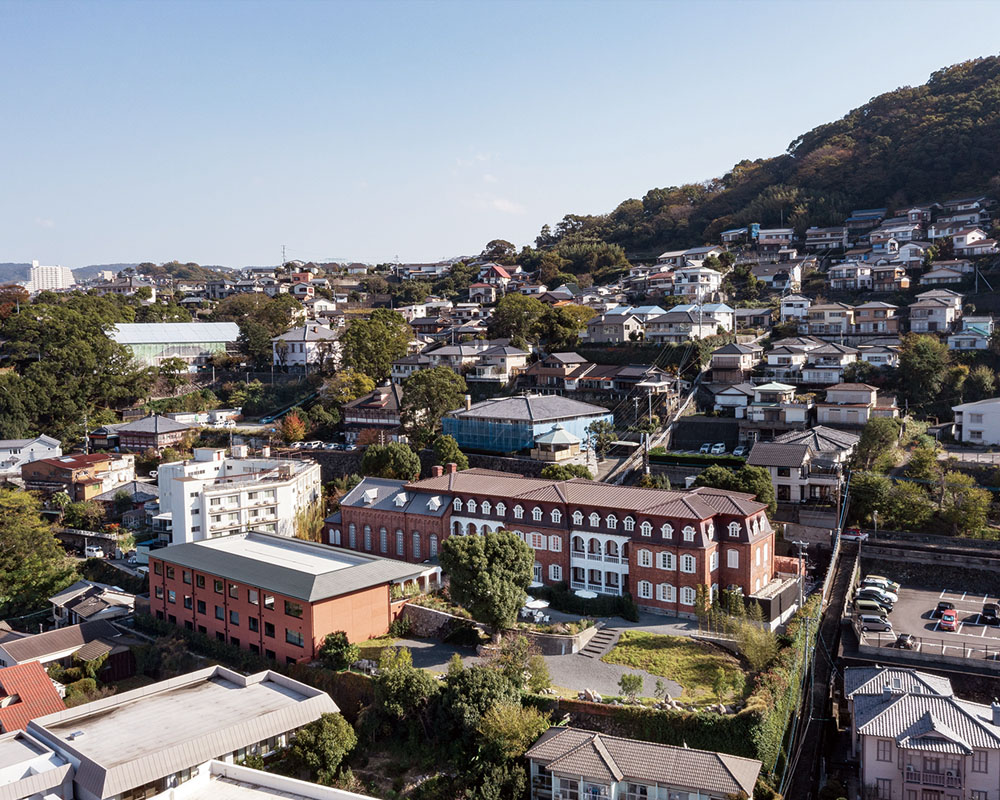
A one-of-a-kind luxury hotel that breathes new life into a historic red-brick building through conversion
During Japan’s period of national seclusion, Nagasaki Prefecture was the country’s sole window to foreign trade. Following the opening of the country, one of the foreign settlements developed on the hillsides of Nagasaki City was the Minamiyamate district, overlooking Nagasaki Bay. This area is home to a number of important cultural properties, including Oura Cathedral, a National Treasure and World Cultural Heritage site; the Glover House, the oldest surviving wooden Western-style residence in Japan; and several stone and brick buildings more than a century old.
Completed in December 2024 within this district—designated as a Preservation District for Groups of Traditional Buildings—Hotel Indigo Nagasaki Glover Street is a unique luxury hotel created through the conversion of a historically significant red-brick structure built in 1898. Over its approximately 130-year history, the building has served successively as a convent, a girls’ school, and a children’s welfare facility. Structural engineer Takuya Yasuda and architectural designers Shinobu Matsushima and Hitoshi Nakamura, who were responsible for the design of the project, explain:
“In repurposing this red-brick building—formerly used as a children’s welfare facility (Maria Garden)—into a hotel, the client, Mori Trust, appears to have placed its expectations on our experience with the conversion of the Handa Red Brick Building in Handa City, Aichi Prefecture, which was also completed in 1898. While there were significant challenges, including issues related to seismic performance, we believed this was a building truly worth preserving. With that conviction, we began exploring various options for its regeneration and undertook detailed on-site investigations.”
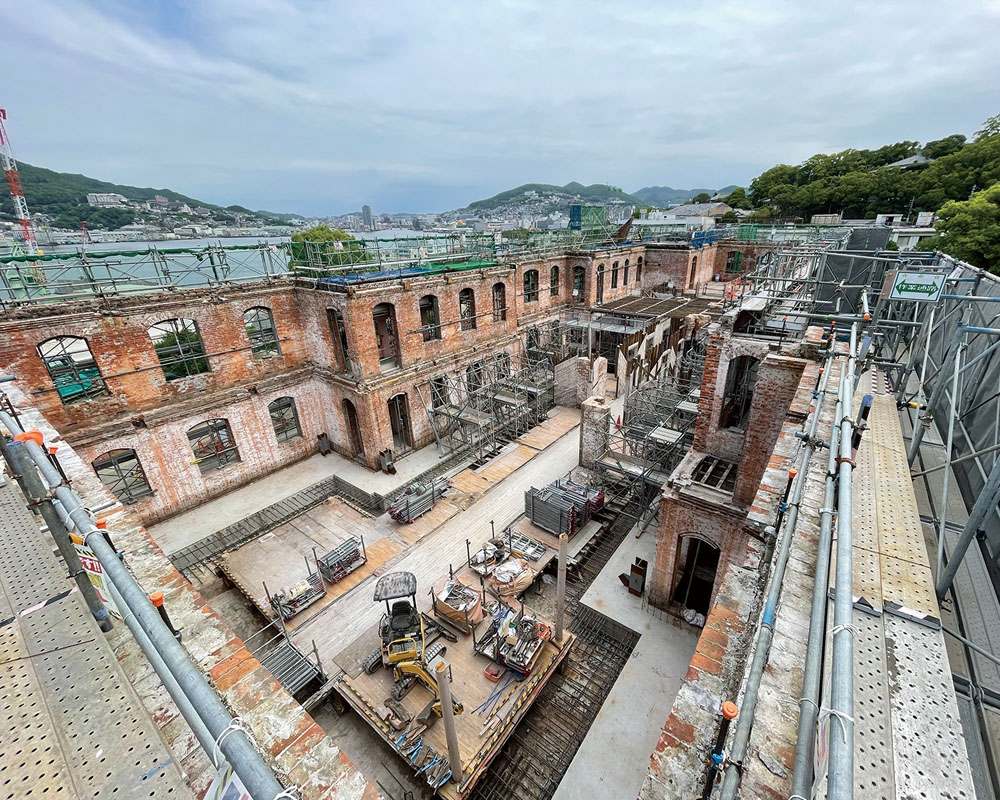
For seismic reinforcement, 160 rebars were inserted into the brick exterior walls. A hybrid reinforcement strategy was further implemented, connecting the brick walls to steel frames and slabs
Converting a building of approximately 130 years old into a hotel requires a wide range of renovations, beginning with seismic reinforcement. In addition, because the Minamiyamate district is designated as a Category I Low-Rise Exclusive Residential Zone, constructing a hotel there requires a special exemption under Article 48 of the Building Standards Act. Accordingly, the design team proceeded with an application to the Building Review Board while also holding explanatory meetings with local residents regarding the hotel project.
“If there had been any opposition, the hotel could not have been built. However, former Maria Garden is a familiar presence for local residents—some people even attended the site when it was still a nursery. The desire to preserve this building, which has long been cherished by the community, was shared by the client, the City of Nagasaki, and the local residents,” say Matsushima and Yasuda.
While all parties involved hoped to preserve and reuse the building, the question remained of how to regenerate an aging structure with no original drawings. Nakamura explains that accurately understanding the existing condition was essential in determining appropriate repair methods.
“We began with a seismic assessment and carried out detailed investigations over time. We examined how Maria Garden had originally been constructed, confirming the locations and dimensions of walls and window frames, as well as the strength of the bricks. For the window frames and stained glass, we obtained permission from the city’s cultural heritage division to temporarily remove certain elements and, with the cooperation of specialists, investigated when they were made and what materials were used.”
As a result of these assessments and surveys, 160 steel reinforcing rebars were inserted into the brick walls designated for preservation as cultural assets. The roof and internal timber elements, which had suffered significant deterioration, were entirely removed, and a bold structural reinforcement was undertaken in which the interior was reconstructed as a steel frame.
Renovation projects are often said to involve high hurdles, and these constraints become even more severe when dealing with buildings treated as cultural properties. To this regard, the design team comments:
“In this case, the interior of the building was not subject to preservation requirements, which made it possible to remove it entirely in order to secure seismic performance and to implement a hybrid reinforcement system that integrates the brick walls—strengthened with inserted rebars—with a steel frame. On the other hand, for exterior elements designated for preservation, such as window frames and fittings, there were strict criteria governing repair methods and materials. While we naturally wished to preserve as much as possible, ensuring the performance required of a hotel—including acoustic comfort—was essential. We therefore made detailed proposals regarding materials and repair techniques to the cultural heritage division and engaged in repeated discussions.”
For cultural properties whose preservation is a prerequisite, maintaining the existing condition is the basic principle; however, restoration to a condition verified through documentation is permitted. Buildings that have lived long lives inevitably undergo repeated modifications. Based on on-site investigations, dismantling work, and documentary evidence, the team also undertook restorations that brought the building closer to its original state.
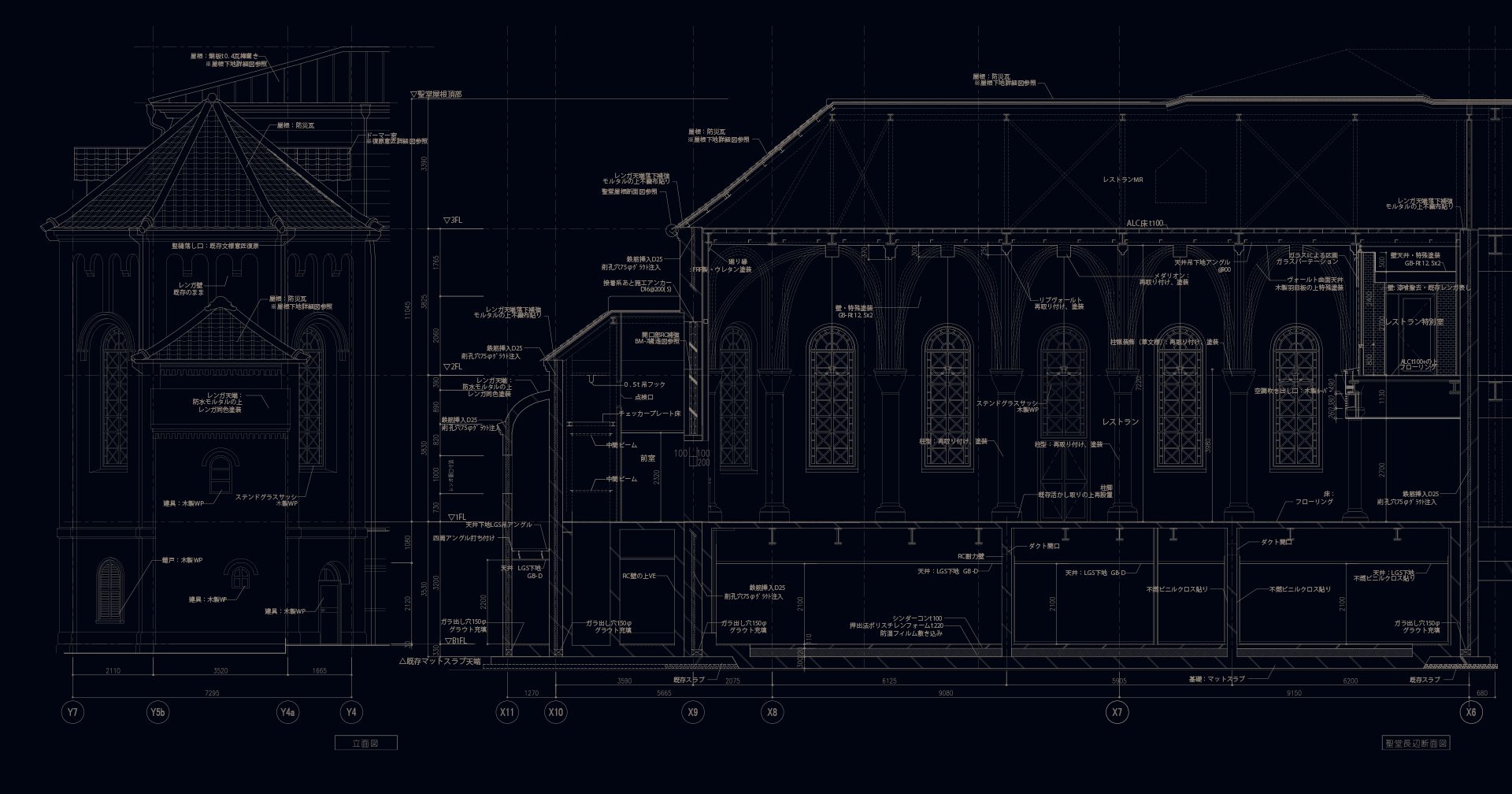
“The roof, which had been doubled as a measure against water leakage, was restored to its original copper-sheet finish. Dormer windows that appeared in photographs from around fifty years ago were also reinstated, based on on-site verification. Inside, the cathedral—with its rib vault ceiling, columns, and stained glass—retains high cultural value. Responding to the shared wish of the City of Nagasaki and Mori Trust to preserve it, we renovated this space into a restaurant,” says Nakamura.
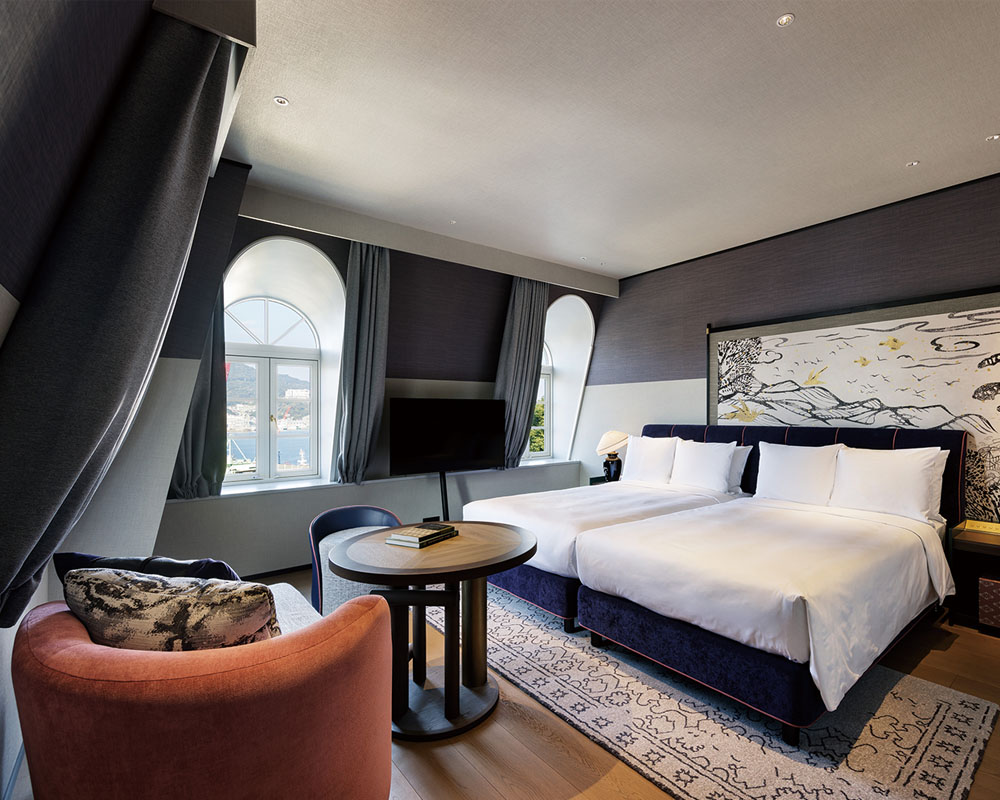
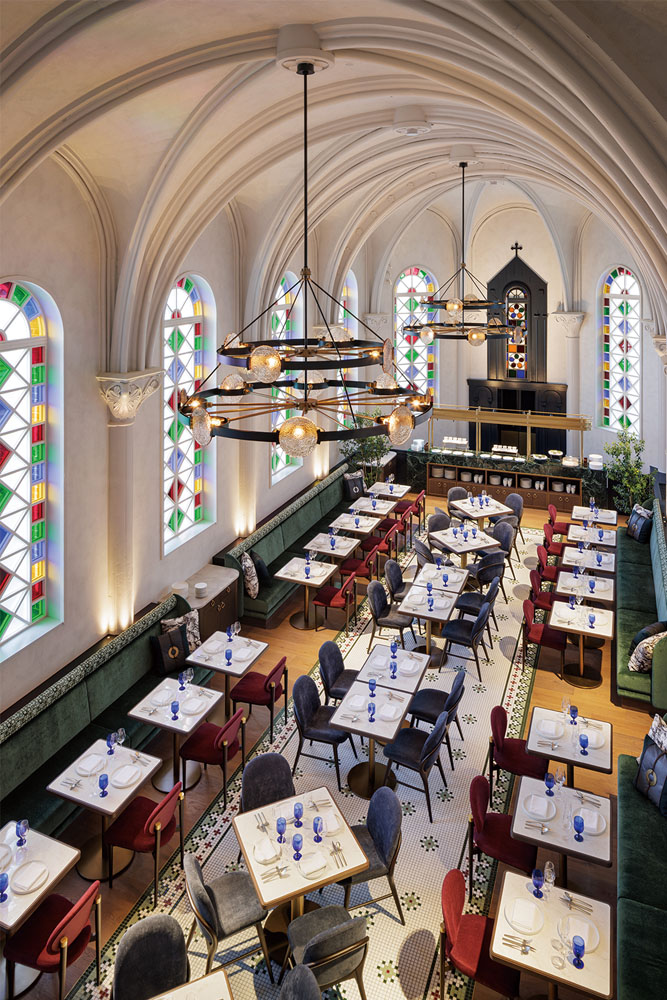
The interior concept draws on Wakaran culture and Nagasaki Saruku:
a hotel that allows guests to experience Nagasaki through a presence and atmosphere unattainable in new construction
Wakaran culture—the fusion of Japanese, Chinese, and Western influences—and Nagasaki Saruku, a local expression meaning to stroll through the city. Taking these two elements that symbolize Nagasaki as its guiding concepts, the hotel’s interior design creates a space in which guests stepping into the lobby can sense the atmosphere of a place that once flourished as a hub of international trade. Mosaic tiles inspired by Nagasaki sarasa textiles, decorative doors referencing the shuttered facades of Western-style houses, and furnishings aptly described as imported goods all contribute to this experience.
“The interior designers translated Nagasaki’s image as a city long engaged in exchange with foreign cultures into the design. While using rich colors and patterns throughout the rooms and shared spaces, they achieved a sense of balance and calm,” says Nakamura.
Most red-brick buildings of the same era that have been preserved and repurposed in various locations were originally built robustly as warehouses. By contrast, Maria Garden—continuously used as a place of residence for more than 120 years—is, in a sense, an exceptional case. The designers agree that its very survival is almost miraculous.
“Maria Garden is unusual for a brick building in that it has many windows. This is why we chose not only to insert steel reinforcement into the brickwork but also to adopt a reinforcement strategy that integrates the walls with a steel frame. Traditional buildings that have survived for around 130 years constitute a high-quality social asset and form part of the landscape. By connecting a building that would otherwise decay to the future through architectural technology, we can preserve it as part of the city. I believe this, too, is part of our work,” says Yasuda.
“When we were able to reconstruct the building after removing the interior and leaving only the brick walls, I was genuinely moved. Breathing new life into a building so that it can embark on a second or third life—if this project can serve as an example of that, I would be very pleased,” says Matsushima.
“When renovating an Important Cultural Property, the request is typically to restore the building exactly as it once was. In this case, however, the premise was to adapt it for use as a hotel, which required meeting seismic standards and carrying out renovations appropriate to contemporary use. We feel a sense of pride that, by gaining the understanding of Nagasaki City officials for proposals aimed at enhancing the building’s value, we were able to create a hotel that effectively conveys the history of the former foreign settlement,” says Nakamura.
As some guests have remarked, staying here allows one to truly experience Nagasaki. This distinctive presence and aura—so different from that of newly built hotels—may well be the hotel’s greatest appeal.
Design in charge:
Approach
Featured Work